Broken Oath Endgame Guide: Ruptures, Wounds, Sigils & Bosses — Broken Oath ARPG
Broken Oath playtest endgame guide covering Rupture Level milestones, Wounds, 51 Sigil entries, The Core pressure tiers, 31 Guardians, and Quality Stones.
On This Page (10)
Endgame progression in the playtest (game build 95) starts on the Rupture Map across eight danger bands and continues onto the Riven Atlas, where Rupture Levels climb past 150. Along that climb you roll active Sigil modifiers and Oathsteel rites (out of 51 sigil entries in build 95, four downsides are disabled), open Wounds in The Bleeding Trial, enter The Core, fight 31 Guardians alongside Riven Lords and Pinnacles, and finish gear with Quality Stones, Support Tempering, and Oathstone Cube recipes.
Endgame Loop: From the Rupture Map to the Riven Atlas
Every Rupture in the playtest generates a fresh layout with randomized weather, time of day, enemy packs, and a Guardian waiting at the finish. You begin by clearing eight escalating danger bands on the Rupture Map before moving into the Riven Atlas, where Rupture Levels scale past 150 and hidden realms plus Pinnacles open as you climb.
Biomes rotate across swamps, snow peaks, deserts, forests, and the Underrealm. Patch 93 also gave Straw Tundra and Gilded Dunes their own map names and raised how often both lands appear starting at Rupture Level 40.
New characters can prepare with the Broken Oath beginner and leveling guide and plan pathing in the passive tree planner. For Wound mechanics and level breakpoints, see the Wounds and Rupture Levels guide, compare setups on the Bleeding Trial builds leaderboard, and check modifiers in the Ruptures and Sigils database.
Rupture Level Milestones and Bleeding Trial Ladder Distribution
In game build 95, key endgame unlocks, crafting stations, and drop rules activate at set Rupture Level and monster level thresholds across Patch 93 and the build 95 game data.
| Threshold | System change or unlock | Endgame impact |
|---|---|---|
| Below Rupture Level 30 | Plain enemies drop half as many potions and magic enemies drop 30% fewer | Flask discipline matters earlier before high-density packs arrive |
| Rupture Level 40 | Straw Tundra and Gilded Dunes appear more frequently under their own map names | Expands biome rotation as you climb |
| Up to Rupture Level 60 | Guardians give 0.3 seconds extra warning before close Charge and Leap attacks | Boss telegraphs tighten above Rupture Level 60 |
| Monster level 60 | Six event omen sigil upsides enter the pool | Opens targeted event farming across all six event omens |
| Rupture Level 100 | Support Tempering unlocks at the Forge, Ancestor Idol +1 lines start dropping, and Resist Turning adds Poison | Major power jump across support gems, idols, and resistance fixing |
| Rupture Level 110 | All 9 Dwarven Rune Socket nodes on the passive tree unlock with free swapping | Lets endgame trees slot a Dwarven Rune into each of nine dedicated sockets |
| Rupture Level 120 | Rivenstones start dropping (lowered from 150) and drop twice as often in events, the Catacombs, the Core, and Pinnacles | Accelerates top-end Forge crafting well ahead of the 150 benchmark |
| Rupture Level 150+ | Developer balance benchmark on the Riven Atlas | Target tier for measuring class, skill, and passive build ceiling |
On the Bleeding Trial ladder (softcore trade snapshot taken on 2026-11-28), 9,008 ranked heroes (alongside a 1,200-hero published build sample) split across nine non-overlapping Rupture Level brackets.
| Rupture level band | Ranked heroes |
|---|---|
| RL 0 to below 25 | 5,221 |
| RL 25 to below 50 | 1,700 |
| RL 50 to below 75 | 948 |
| RL 75 to below 100 | 348 |
| RL 100 to below 125 | 151 |
| RL 125 to below 150 | 230 |
| RL 150 to below 175 | 143 |
| RL 175 to below 200 | 154 |
| RL 200+ | 113 |
Across those 9,008 heroes on the Bleeding Trial ladder, class representation splits between  Necromancer at 2,062 heroes (22.9%),
 Ranger at 1,854 (20.6%),
 Mage at 1,709 (19%),
 Warrior at 1,273 (14.1%),
 Paladin at 1,056 (11.7%), and
 Samurai at 1,054 (11.7%). Compare each class toolkit across the classes directory, skills index, keystones list, and notables database.
Sigils: Upsides, Downsides, and Oathsteel Rites
Game build 95 lists 51 sigil entries split across upsides, downsides, and Oathsteel rites, with four downsides marked disabled in the build data. To cut downtime between maps, game settings also let you auto-buy Sigils while chaining Ruptures.
Sigil Upsides, Event Omens, and Uncapped Upsides
Standard scaling upsides raise farming rewards from their base roll up to a hard cap:
- Augury — 14.6% base increased sigil find, scaling up to a 200 cap.
- Avarice — 20% base increased gold, scaling up to a 274 cap.
- Champions — 14.6% base more magic and rare monsters, scaling up to a 200 cap.
- Fortune — 14% base increased item rarity, scaling up to a 192 cap.
- Hoard — Guardian drops 1 extra item up to a 4 cap, and at tier III and tier IV that drop rolls rare and brings Oathsteel.
- Horde — 5% base increased pack size, scaling up to a 69 cap.
- Insight — 10% base increased experience, scaling up to a 137 cap.
- Plenty — 6% base increased item quantity, scaling up to an 83 cap.
Six event omen upsides require monster level 60 and share a 20 cap: the Circle (Warding Circle, +3% jackpot chance), the Courier (Oath-Courier, +3% jackpot chance), the Cursed Hoard (Cursed Hoard, +3% jackpot chance), the Obelisk (Ancient Obelisk, +3% jackpot chance), the Seals (Broken Seals, +3% jackpot chance), and the Wound (The Wound, whose spoils roll 4 Rupture Levels deeper). Three uncapped upsides break past normal ceilings with no cap value: the Hoardking grants 44% increased item rarity, the Endless Muster grants 17.5% increased pack size, and the Broken Seer grants 44% increased sigil find.
Sigil Downsides and Named Land Pairings
Active sigil downsides span danger ranks 1, 2, and 3 and dictate which defenses your build must solve before juicing maps in game build 95. Active combat penalties raise monster damage by 15% or 25%, grant monsters 20% extra fire, cold, or lightning damage from physical hits, raise monster life by 15% or 20%, lower your maximum resistances by 5% or 10%, cut life and mana regeneration plus leech by 30%, drop falling ash and frost underfoot, or return 5% of your hit damage capped at 1% life per hit. Active pack-pressure downsides add 8% monster movement speed, 15% attack and cast speed, 15% Hasted packs, or 1 extra rare monster affix (danger 3).
Several high-risk downsides reshape the boss arena or enemy roster:
- Siege Arena (danger 3) — rocks, lightning, and catapult stones strike the Guardian arena every 3.5 to 7.5 seconds, paying out 40% increased item rarity and 20% increased item quantity.
- Two Guardians (danger 3) — two Guardians share the boss arena, each spawning with three quarters of normal life.
- Usurper (danger 2) and Raiders (danger 1) — pull either a Guardian or an extra war band from another land into the run, while another danger 2 downside gives the Guardian 1 extra modifier.
Seven biome-paired downsides trigger special weather or named land pairings when matched to their home terrain: Wild Land (8% faster monsters on forest lands), Dust Storm (15% Hasted packs with desert sandstorms), Deep Land (15% more monster life in deep caverns), Bog Land (20% more monster life on swamp lands), Frozen Land (15% more monster damage in snow blizzards), Nightfall Land (20% of physical damage gained as extra elemental on crypt lands), and Ashen Land (ash and frost ground hazards on fire lands).
Oathsteel Rites
In game build 95, four Oathsteel rites spend 1 or 2 Oathsteel to lock in a focused farming bonus paired with a fixed danger mod.
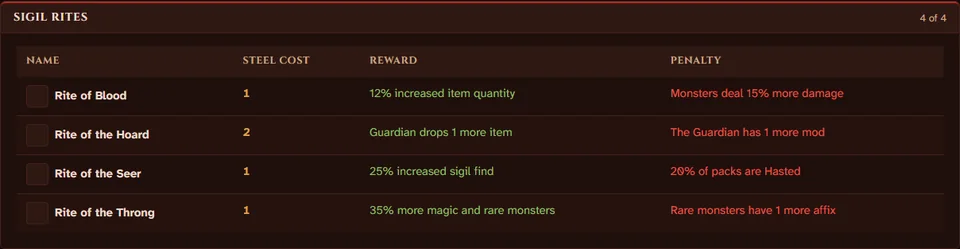
| Rite | Oathsteel cost | Reward | Penalty |
|---|---|---|---|
 Rite of Blood |
1 | 12% increased item quantity | Monsters deal 15% more damage |
 Rite of the Hoard |
2 | Guardian drops 1 more item | The Guardian has 1 more mod |
 Rite of the Seer |
1 | 25% increased sigil find | 20% of packs are Hasted |
 Rite of the Throng |
1 | 35% more magic and rare monsters | Rare monsters have 1 more affix |
Review defensive layers in the Blessings list, Curses database, and oath masteries catalog before stacking high-danger rites.
Wounds in The Bleeding Trial
In The Bleeding Trial playtest, Wounds appear as broken-oath rifts torn across the world. Opening a Wound bleeds monsters into your Rupture, letting you decide whether to close the tear early or push deeper into the encounter for stronger rewards.
At monster level 60 and above, rolling  the Wound event omen sigil spawns The Wound on your map and pushes its spoils 4 Rupture Levels deeper. Combine that omen cautiously with danger 3 downsides such as -10% to your maximum resistances or 30% less life and mana regeneration and leech, since sustained Wound fights test recovery fast.
The Core and Pressure Tiers
In game build 95, The Core pairs a four-Guardian boss pool with ten Pressure tiers.
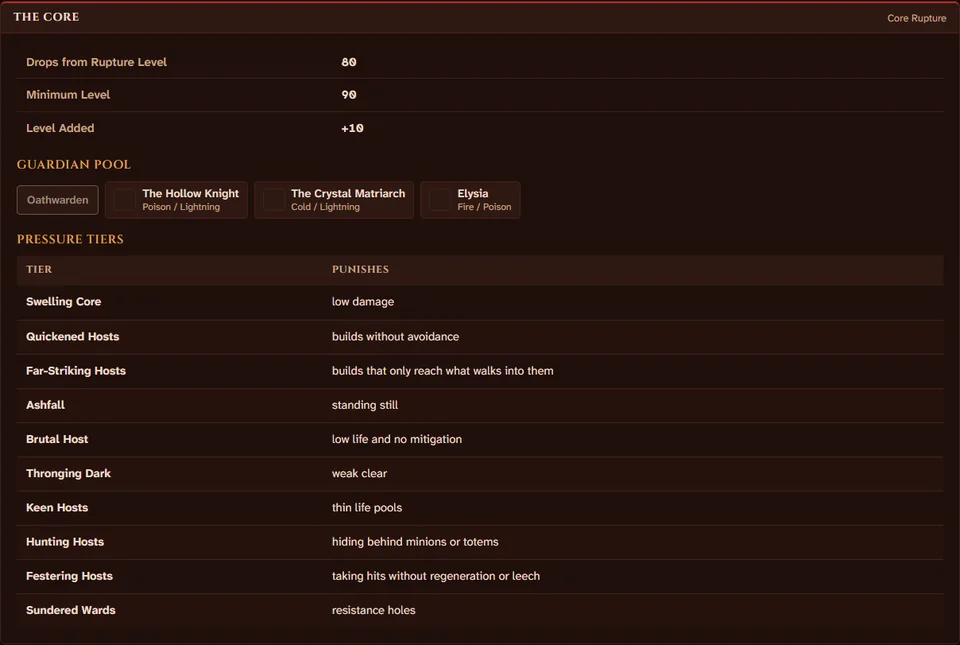
Runs inside The Core draw from a four-Guardian pool made up of Oathwarden,  The Hollow Knight,
 The Crystal Matriarch, and
 Elysia. From Rupture Level 120 onward, Rivenstones drop twice as often from the Core alongside events, the Catacombs, and Pinnacles.
Every Pressure tier targets a specific build weakness in exchange for escalating loot rewards.
| Tier | Punishes | Danger modifier | Reward modifier |
|---|---|---|---|
| Swelling Core | low damage | +25% monster life | +8% item quantity |
| Quickened Hosts | builds without avoidance | 30% Hasted packs | +20% item rarity |
| Far-Striking Hosts | builds that only reach what walks into them | Ranged packs (40) | +20% sigil find |
| Ashfall | standing still | Ground hazards (8) | +8% item quantity |
| Brutal Host | low life and no mitigation | +25% monster damage | +1 Guardian drop |
| Thronging Dark | weak clear | +20% pack size, +25% magic and rare monsters | +10% item quantity, +10% experience |
| Keen Hosts | thin life pools | Monster critical chance (10) | +30% item rarity |
| Hunting Hosts | hiding behind minions or totems | Monster fixate (35) | +30% sigil find |
| Festering Hosts | taking hits without regeneration or leech | Monster fester (20) | +1 Guardian drop |
| Sundered Wards | resistance holes | -8% maximum resistances, +25% monster life | +24% item quantity |
Core-tagged limited uniques include  The Oathwarden’s Chain and
 Dwarven Rune of the Falling Sky, which you can inspect alongside all 457 uniques in the uniques database and all 58 Oathwords in the Oathwords index.
Guardians, Riven Lords, Gate Bosses, and Pinnacles
Game build 95 features 31 Guardians at the end of Ruptures. Every Guardian shares base life of 820, base experience of 300, and Stagger Resist of 3.0 before Rupture scaling, while base armour is 25 for most bosses, 30 on  The Deep Hall Warden,
 The Oathsmith,
 The Shellback Tyrant, and
 The Steel Guardian, and 20 on
 The Weaver Queen.
Thirty of the 31 Guardians carry a +20% resistance and -20% weakness elemental shift pair, leaving only  The Magic Construct with no elemental shift row. All 31 Guardians except The Deep Hall Warden and The Magic Construct also list a Signature Rune entry — including
 Kaun on The Hollow Knight,
 Isa on The Crystal Matriarch, and
 Dagaz on Elysia.
Patch 93 changed how boss phases play in the playtest: most Guardians stay in the arena until defeated instead of departing mid-fight, whereas Riven Lords, Pinnacles, and Gate bosses still leave partway through their encounters. Up to Rupture Level 60, Guardians also telegraph close Charge and Leap attacks 0.3 seconds longer.
Riven Lords wait deeper in progression inside dedicated arenas built around multi-phase slams and red ground telegraphs. Once you reach Rupture Level 120, events, the Catacombs, the Core, and Pinnacles drop Rivenstones twice as often. For attack tables and target farming routes, visit the Guardians, Riven Lords, and Pinnacles guide, the Guardians directory, and the runes database.
Quality Stones, the Forge, and Endgame Farming Prep
In game build 95, Quality Stones drop starting from area level 8 at 0.36% from Normal monsters, 1.2% from Magic monsters, 3.6% from Rare monsters, and 60% from Guardians, with 40% of those drops rolling as whetstones. Quality caps at 20%, and each stone adds 5% on Normal items, 2% on Magic items, 1% on Rare items, and 1% on Unique items.

Using your Quality Stones while a base item is still Normal reaches the 20% cap in four stones instead of twenty, and the Blank Slate cube recipe lets you strip a magic or rare weapon, body armour, helmet, or shield back into a plain white Oathword base while keeping its Quality, Mark, item level, and sockets.
In game build 95, endgame crafting pairs Forge stations with The Oathstone Cube (44 recipes):
- Support Tempering — unlocks at the Forge at Rupture Level 100 and adds 5 small levels per support gem, reducing its less damage penalty and Cost multiplier; compare gem multipliers in the support gems index.
- Idol Recast — rerolls a magic or rare idol at the Forge for Glyph Shards while preserving +1 lines that start dropping at Rupture Level 100.
- Oathsworn — combines a rare item, a Tier V+ rune, and 3 Core Embers in The Oathstone Cube to add a 7th Oathsworn line at the highest tier its item level allows, and a Vow can never take it.
- Resist Turning — spends 1 Tier I to IV rune and 1 Core Ember to swap a spare resistance into your lowest element (adding Poison at Rupture Level 100) without changing its tier or roll.
- Retempering — uses 2 Tier II+ runes and a Cut or finer jewel to reroll all mods on a rare at the current Rupture’s higher monster level up to item level 84.
- Dwarven Carving and Dwarven Mending — Dwarven Carving upgrades a Normal or Magic Dwarven Rune one rarity higher with fresh lines using 1 Tier III or IV rune, 2 Cut or finer jewels, and Core Embers stored at the Forge (4 to reach Magic, 10 to reach Rare), while Dwarven Mending melts and rerolls the weakest line on a Rare Dwarven Rune for 1 Tier III or IV rune, 1 Cut or finer jewel, and 3 Core Embers; the 9 passive Dwarven Rune Socket nodes unlock at Rupture Level 110.
Quality-of-life updates from Patch 93 speed up long farming sessions as well: the Forge highlights which Rivenstone T0 lines cost extra, Rivenstone and pinnacle pickups remain visible longer, the stash sorts runes by tier, and the loot filter supports Salvage. Plan your passive pathing toward the 9 Dwarven Rune Socket nodes in the passive tree and Heart Waygate guide, and check endgame crafting ingredients across the Oathstone Cube recipes page, item bases list, affixes table, and mythic lines directory.
Data: Broken Oath public API, build 95 • Broken Oath on Steam